

There’s an old line about the cobbler’s children having no shoes. I’ve always liked it because it’s a good reminder and annoyingly true. The people who know better are not, in fact, immune to doing worse.
This TriMetrix Tale is one of those stories.
We were hiring for an internal recruiting role using the system we know well, trust deeply, and regularly use with our clients. We had a benchmark. We had data. We had a process. And still … we let ourselves get pulled off course by something very human.
The candidate was likable. Very likable. He was highly educated, eager to learn our system, intellectually curious, and interviewed well.
And that’s exactly why this story matters.
The Interview Looked Better Than the Fit
Nothing about this candidate screamed “bad hire” in the room.
He came across as bright, personable, and motivated. The kind of person who can make you feel like he’ll figure it out. The kind of person who makes you think, “Yes, there are some gaps, but he’s so smart and so eager … maybe he can grow into it.”
That was our first mistake.
TriMetrix doesn’t tell you whether someone is good or bad. It tells you whether the person is naturally aligned with the demands of the role. And in this case, the data was telling a much more predictive story than the interview was.
What the DISC Behaviors Were Telling Us
At a glance, his DISC looked appealing for recruiting in some ways. He had strong Influence behavior and moderately strong Dominance. Ahhh, the classic Persuader profile. The job also called for a lot of interaction with others and on that front there was alignment. The behavioral hierarchy showed Interaction at 90 for both the job and the candidate.
So far, so good.
But the more revealing gaps were underneath that.
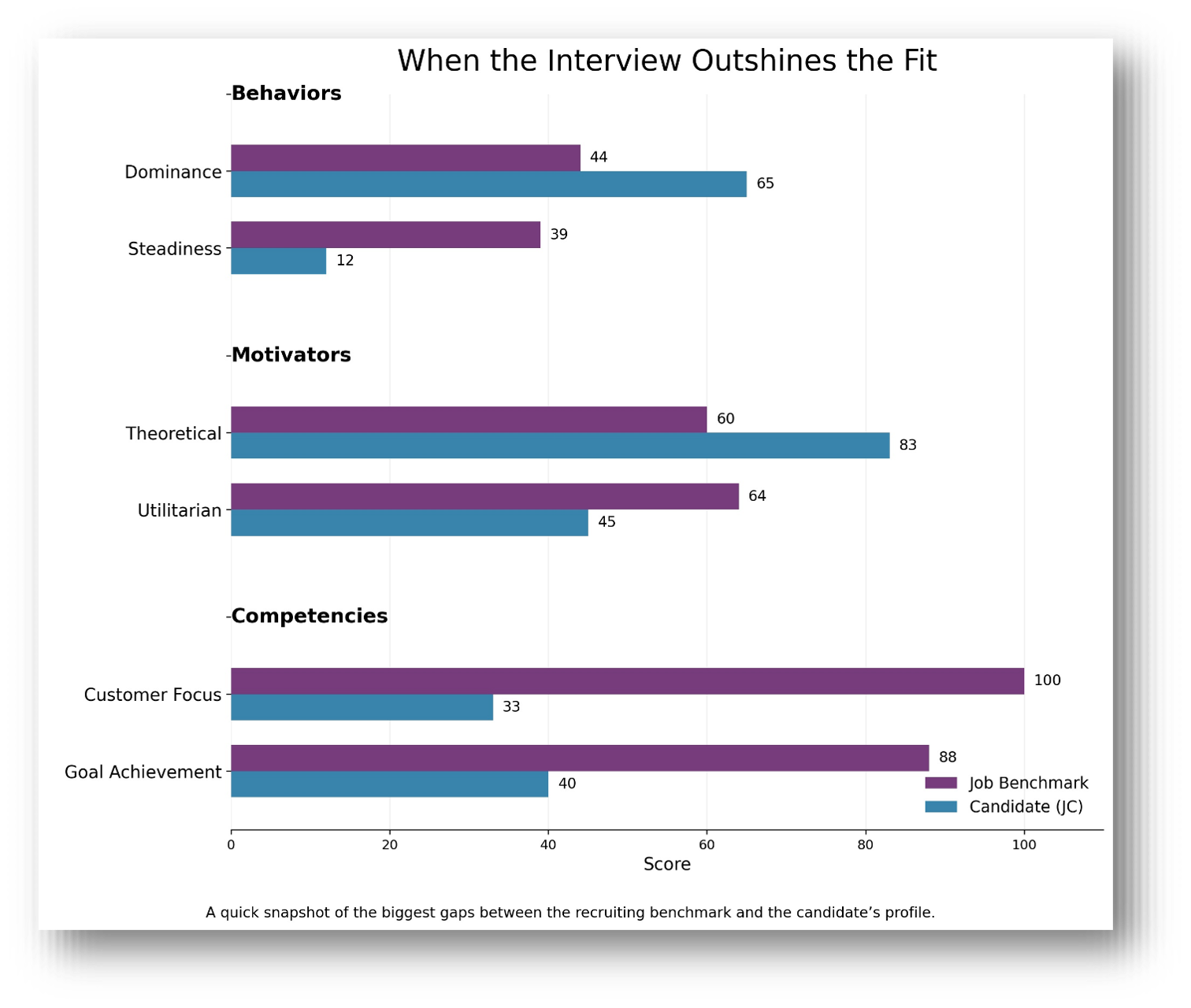
The benchmark called for D at 44, while his natural D was 65. The job called for S at 39, while his natural S was 12.
That combination matters.
A somewhat higher D with very low S can create someone who moves quickly, gets impatient easily, resists staying with one thing for long, and doesn’t naturally slow down enough to create consistency or follow-through. In real life, that can look like bouncing from task to task, starting strong, talking confidently, and then not staying with the work long enough to convert effort into completed output.
And that is very different from simply being “high energy.” We didn’t need someone who could only start projects with momentum…we needed someone who could sustain it.
The Motivator Gap Was Even More Telling
This was, to me, one of the loudest clues.
The role benchmark was heavier on Utilitarian/Economic, with the job at 64, and more moderate on Theoretical, with the job at 60. He came in at 45 Utilitarian and 83 Theoretical.
That’s not a tiny difference… because of what it means when those drivers are flip-flopped.
High Theoretical people love learning, exploring, understanding, researching, mastering concepts, and often sharing what they know. There is nothing wrong with that. In many roles, it’s a huge asset.
But in a recruiting role that requires practical application, responsiveness, throughput, and measurable movement, too much Theoretical without enough Utilitarian can become a problem.
You get someone who enjoys the ideas around the work more than the production of the work.
Someone who can talk about methods, frameworks, insights, and possibilities (oh, the possibilities!)… but may not feel the same natural urgency around outcomes, efficiency, or practical results.
Add in a moderate Individualistic score of 50, and now you may also get some confidence around those ideas. Sometimes that shows up as conviction. Sometimes it shows up as defensiveness. Sometimes, frankly, it shows up as a little bit of a know-it-all.
And yes … that showed up too.
The Competencies Were Waving a Flag
If the interview made us feel optimistic, the competencies should have brought us back to earth.
The role benchmarked Customer Focus at 100, but he scored 33.
The role benchmarked Goal Achievement at 88, but he scored 40.
That low Customer Focus matters more than people sometimes realize. In an internal recruiting role, your customer is not just the candidate. It’s also the hiring manager, the leadership team, and the company’s you are helping to make smart decisions on behalf of real business needs.
If customer focus is too low, the person may not stay tuned in to who the role is actually there to serve.
Then there was Goal Achievement. This one hurts a little because Goal Achievement (along with Personal Accountability and Self-Management) is the TRIFECTA we look for in all candidates. It’s such an obvious MISSING in hiring a Recruiter, we did a literal *palm to the face* when we went back to the data and realized we over-looked it.
He also had very high Continuous Learning and high Presenting in his profile. And that combination can be seductive. A person who learns quickly and presents well often feels highly capable in an interview. They can explain themselves beautifully. They can sound sharp. They can create confidence in the room.
But presenting well is not the same as producing well. That’s one of the biggest lessons in this whole story.
What Happened After the Hire
What eventually showed up was not some dramatic disaster. Honestly, it was more frustrating than dramatic.
He had a short attention span, he moved around a lot and he struggled to stay with things long enough to complete them in a useful, tangible way. There was more energy around learning and talking than around consistent execution. And when that gap was challenged, there was some defensiveness around it — a sense that what he was doing should count as the right thing.
That part matters too.
Because the hardest hires are not always the obviously wrong ones. Sometimes they are the hires with enough strengths to keep you second-guessing your own concerns.
The Bigger Lesson
This isn’t a story about a bad person. It’s a story about a mismatch … and about what happens when smart people override their own tools because they like the person standing in front of them.
We’ve all done some version of this.
We see the charm, the polish, the degrees, the confidence, the enthusiasm, the potential. We tell ourselves the person can grow into the role. We focus on what is appealing and minimize what is predicted.
And then later, the benchmark we ignored starts quietly tapping us on the shoulder like, “Hi… it’s me again.”
That’s why I’m sharing this one. Not to shame anyone and certainly not to be smug. Quite the opposite. Because sometimes the best testimonial for our system is when it isn’t followed and the users should have known better.
Final Takeaway
If you ignore your hiring benchmark, sometimes who gets hired isn’t the best fit for the role … it’s the candidate who made the strongest impression.
That’s the whole lesson.
TriMetrix is most helpful when it keeps us honest — especially when we’re tempted to trust our gut a little too much. The benchmark doesn’t replace discernment. It protects us from the ways discernment gets cloudy when someone is bright, engaging, and easy to root for.
And that, I think, is the real cobbler-has-no-shoes part of this story.
The process works. We just didn’t follow it.
If you’ve ever hired someone who looked terrific in the interview but couldn’t turn talent into traction, let’s talk.
👉 Book a call to discuss team member alignment and how TriMetrix can help you spot it before the cost shows up in real life.