

My husband and I met at a TriMetrix training.
I know – it sounds too ironic – but it’s true.
Back in 2013, both of us were sitting in a TTI class learning how to debrief the TriMetrixHD – the very model that would one day reveal our supposed “incompatibility.”
We didn’t even talk that first meeting.
A year later, we crossed paths again at the TTI Annual Conference and realized we’d been in the same training the year before. Then, as fate (and a shared mentor) would have it, we kept bumping into each other – in sessions, hallway chats, and discussions about client assessments.
For a while, we were just friendly associates. We’d compare notes, swap case stories, talk about stress assessments and EQ results – nerdy stuff only people like us find exciting.
Then in 2016, life shifted for both of us.
Our conversations got a little more personal. A little more frequent.
And one day, while talking about our own TriMetrix results, we started laughing.
“Look at us – we’re basically the same person. We’d kill each other in a relationship.”
That’s when he said, “Maybe we should test that theory – for research.” 😉
We did. And, as they say … the rest is history.
The Data: Two High D’s Walk Into a Relationship
When we finally compared our graphs side by side, it was both hilarious and horrifying.
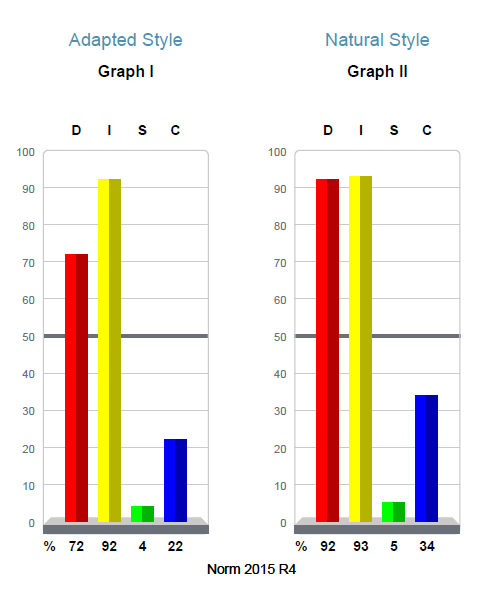
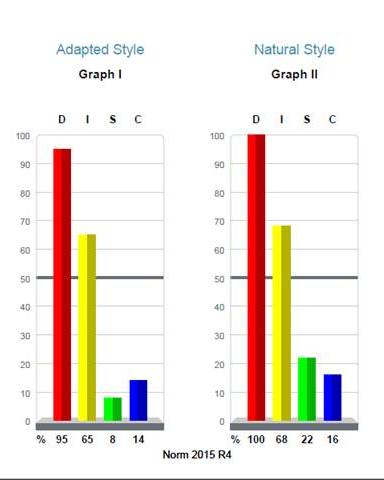
My DISC: D 92 | I 93 | S 5 | C 34
His DISC: D 100 | I 68 | S 22 | C 16
(see graphs below)
Two high D’s – two people who never wait for permission – with almost no S between us. We move fast, decide fast, and expect others to keep up.
But, my Influence was 93% – just one point higher than my Dominance.
The difference is subtle but important.
🪄 Translation: Two race cars on the same track — but I’m the one waving to the crowd as we pass; he’s the one checking the lap time. Both effective – just in different ways.
The Motivators: Same Fuel – Different Spark
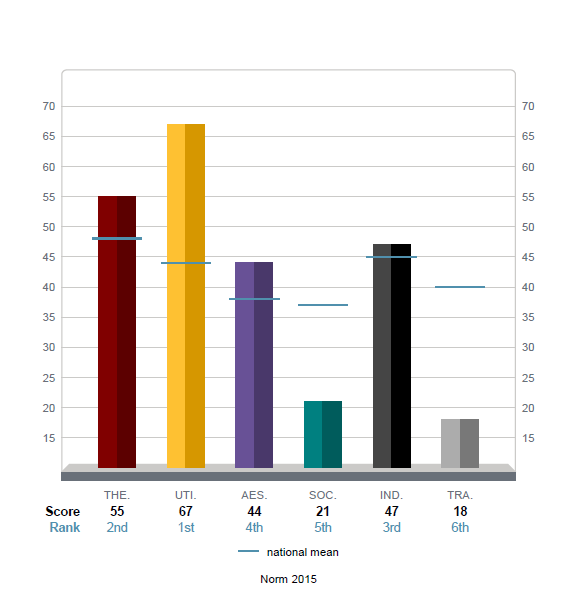
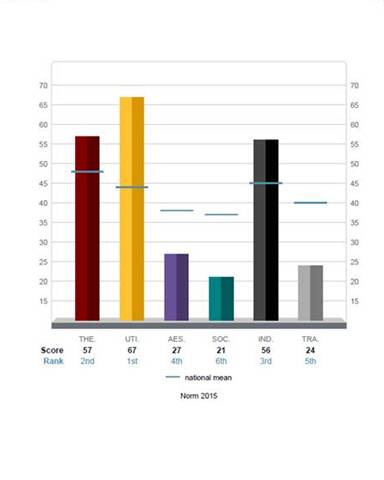
Mine: Theoretical 55 | Utilitarian 67 | Aesthetic 44 | Social 21 | Individualistic 47 | Traditional 18
His: Theoretical 57 | Utilitarian 67 | Aesthetic 27 | Social 21 | Individualistic 56 | Traditional 24
(see graphs below)
We’re both ROI-driven, bottom-line thinkers who like autonomy and freedom. We also both score moderate on Theoretical – we enjoy learning when it’s practical and usable… not theory for theory’s sake. Neither of us is motivated by rules or “how it’s always been done.” We’ll help people – but usually because it feels genuine, not obligatory.
He’s slightly more competitive and status-oriented (higher Individualistic).
I’m more relational and experience-seeking (higher Influence and Aesthetic).
He keeps us on course – I make sure the journey feels worth taking.
What the Graphs Didn’t Show
The data said “too similar.”
Reality said “perfectly matched – if approached with awareness.”
Two high-D/low-S, high Utilitarian/low-Social people can burn bright or burn out. The key is knowing what fuels and drains you. When you understand your wiring – and your partner’s – you stop seeing sameness as a struggle for power and start using it as a shorthand.
We’ve built our rhythm around that awareness:
- He anchors when I overcommit.
- I remind him to slow down and connect.
- Together, we create structure only where it serves us – not where it cages us.
💡 The Takeaway
Most people think these tools are for hiring or coaching. But when you really understand what drives you – and what drives the person beside you – it changes everything.
Our TriMetrix data once warned we might drive each other crazy. Turns out, we were just tuned to the same frequency – we just needed to learn the controls. (And in full transparency – of course there are times when we drive each other crazy!!)
Because TriMetrix doesn’t predict love or disaster – it creates awareness.
And awareness … that’s the best kind of love language.
If you’ve ever wondered how two strong personalities can thrive – in business, partnership, or both – let’s talk. TriMetrix doesn’t just reveal who fits the job – it shows how people fit each other.
Jess Results
Nancy Results